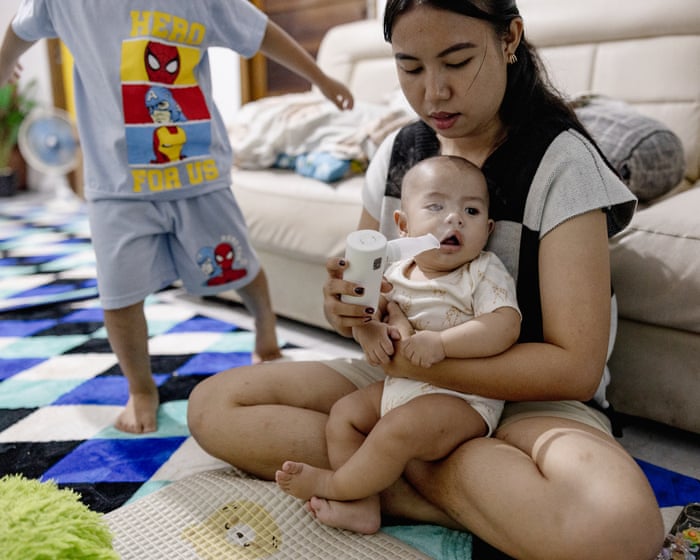
Mother tells of desperate efforts to keep her five-month-old son healthy as residents of Palangkaraya flock to clean-air ‘safe houses’ to escape toxic haze
E very day in Palangkaraya starts with an air quality check. For people who can afford one, a handheld device can test the air for toxic particles floating into their lungs. For others, a look out the window will reveal skies turned orange with smoke.
But for those closest to the fires ravaging this part of Indonesia , the check is done before they even open their eyes, with the acrid smell and the hacking cough that comes as they wake.
On the island of Borneo, people are facing life where the air itself is a threat. Windows are sealed with plastic sheeting, children are locked in bedrooms and families spend evenings inhaling oxygen from tanks.
At the centre of the crisis sits the city of Palangkaraya, home to about ٣٠٠,٠٠٠ residents, who have been besieged for months by wildfires engulfing its surrounding forests. Here, Apri Dona Yusmelita sits on the floor with her five-month-old son. She encourages him to take breaths from a nebuliser – a machine that will transport medicine to the infant’s tiny lungs. He has been sick for most of his short life.
“The cough is phlegmy, so he always has to vomit,” says Yusmelita, who also has a four-year-old. “So it’s like he struggles to catch up to his target weight. Because he’s constantly sick. So whatever he drinks, he vomits it all up, because he coughs so often.”
Since the fires started in July, Yusmelita has regularly had to keep her children in the bedroom where she has an air purifier. The ٢٧-year-old moved the television from the living room to keep them occupied, but rotating power outages can make the days feel longer. Smoky air seeps into the rest of their home.
“Even eating had to be in the bedroom for the kids because their lungs are different from ours,” she says. “We moved everything here, especially when the smoke turned yellow yesterday … So it’s only safe in the bedroom.”
Over the past four months, her family has spent roughly half their time inside that single room. When her mother briefly took the children outside to play, their symptoms flared immediately. “I can’t bear it,” she says. “It’s so pitiful.”
Smoke from annual fires has become a way of life here. Many blazes were started intentionally using the “slash and burn” method of clearing land for crops such as palm oil, of which Indonesia is the world’s largest producer.
This year has been exceptionally bad, with close to ٢m hectares of forest and peatland burned in Indonesia. A “godzilla” El Niño has brought drier-than-usual conditions.
Authorities have been unable to cope with the scale of the catastrophe, meaning it is often local volunteers who monitor air pollution. The Ranu Welum Foundation, a local Indigenous organisation, has been fundraising for smoke “safe houses” equipped with air purifiers, oxygen tanks and nebulisers.
Roro Ardya Garini, ٣٥, a co-founder, says they cater for vulnerable populations – the children and elderly – although on severe days anyone is welcome. “They come just to breathe,” she says. There are now ١٤ of these so-called haze shelters, often in rooms donated by churches or public buildings. The best ones have air-tight concrete walls and minimal ventilation.
The shelters are not a replacement for hospitals, Garini says, and sometimes volunteers have to send people away. Once, a baby arrived blue from acute oxygen deprivation and was quickly sent to the emergency room.
At another shelter operated by the volunteer group JPIC Kalimantan, Sabrina Alfiana supervises her four-year-old son, Fahreza Alfarizqia, as he inhales mist from a nebuliser. Air purifiers are lined up and plugged into the wall, as well as oxygen tanks.
Sabrina, ٢٦, says she keeps her children inside, but sealing her home is a lost cause. “It’s smoke, right? Whether it seeps in through the cracks, the windows, you can still feel it,” she says. “Even inside the bedroom, we can smell the smoke.”
While Palangkaraya is on the frontline of the haze crisis, millions of people across south-east Asia have been breathing air that could be damaging their bodies in ways they cannot predict.
Thick smoke has drifted into Singapore, Malaysia , Brunei and Timor-Leste, even reaching as far afield as the Philippines and Vietnam. Schools have been closed, tens of thousands have been hospitalised with respiratory issues, and residents have been sharing images of rainwater turned black with ash.
In Singapore the government has set up its own air-conditioned haze shelters while Malaysia’s capital, Kuala Lumpur, has seen an uptick in pets brought to the vet. Toxic air has spiked demand for oxygen tanks and air purifiers across the region, manufacturers say.
The Indonesian government has dispatched firefighters and says it will pursue the companies accused of arson, but decades of promises to address the fires have failed.
In Palangkaraya, volunteer Melodyna Adhesiva, ٢٣, is in charge of taking air quality readings and posting the results on social media for the public. The readings monitor levels of PM٢.٥, particulate matter small enough to enter the bloodstream and cause lung damage.
The World Health Organization recommends a ٢٤-hour average of ١٥ micrograms per cubic metre, and in Palangkaraya it regularly reaches ٣٠٠. The worst reading Adhesiva took last month was above ٣,٠٠٠.
Her team has several devices, but the air quality is so bad they’re ineffective. “This one can only reach a maximum of ٩٩٩,” she says, holding a monitor high up in her hand. “So we rarely use it for going out. We sometimes just use it for checking indoors.”
التعليقات · ٠