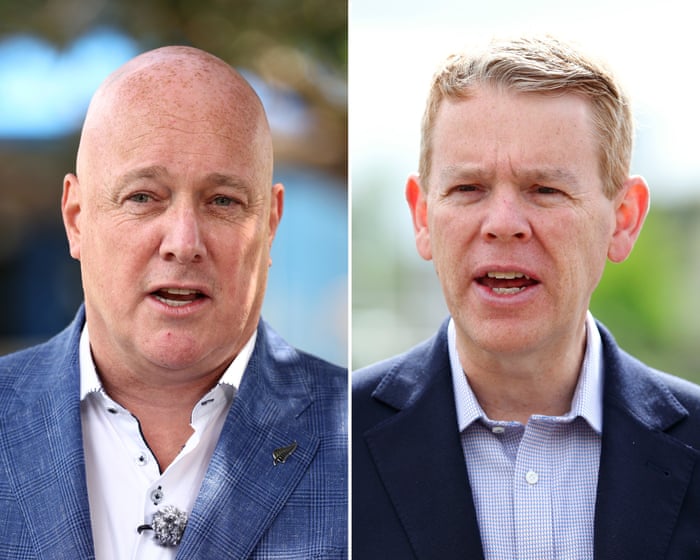
Thanks for following the blog tonight. The election has ended without a clear winner. Here are the top news lines from what will go down as one of New Zealand’s closest elections in many decades .
Christopher Luxon’s National party and its right-leaning coalition partners are on the brink of a wafer-thin majority that could allow it to eke out a return to power.
The left-wing bloc, led by Labour’s Chris Hipkins, fell short of a majority .
Neither Luxon or Hipkins claimed victory or conceded defeat . Both acknowledged an expected wait before a governing coalition is negotiated.
A centrist newcomer, the Opportunity party, has entered parliament, polling above the 5% threshold . They could potentially be a kingmaker in a coalition.
Final results are expected on 27 November . Coalition talks will likely take weeks.
Hundreds of thousands of special votes are yet to be counted and could change the shape of parliament .
Saturday figures showed there could be a 130-seat parliament , with 66 seats needed for a majority.
Results suggested a coalition of National, Act and NZ First would hold 67 seats.
The 67 included 42 for National, 13 for Act and 12 for NZ First.
The left-bloc totalled 56 seats: Labour 35, Greens 16 and 5 for Te Pāti Māori.
Comments · 0