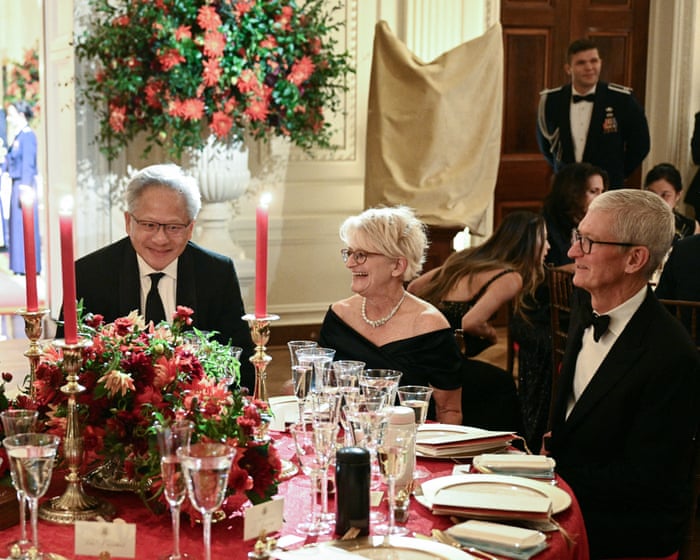
CEO reportedly had close relationship with a Chinese businesswoman who passed information to Beijing
Nvidia said on Sunday it “is initiating an independent investigation in light of recent reporting that founder and CEO Jensen Huang has been the target of a foreign intelligence effort”.
The New York Times reported in October that Donald Trump had been briefed last year on intelligence that Huang had a close relationship with a Chinese businesswoman who passed information to Beijing.
Speaking to reporters on Sunday, Trump downplayed the revelations about Huang, who is an influential adviser to the president on artificial intelligence, saying: “I think he’s an honorable guy. I think he probably has an excuse for it.”
Trump also brushed off a question about whether he now regrets not acting on the intelligence when he was briefed on it, and suggested that he would be happy to take Huang with him on a trip to Asia next week. “I haven’t heard he’s done anything wrong,” Trump said. “He dealt with somebody. But, you know, so does everybody else.”
Republican lawmakers have expressed more alarm, asking Huang to give the House foreign affairs and intelligence committees a closed-door briefing next week on Nvidia’s “security protocols against foreign adversary espionage” and his relationship with Alice Huang or Huang Le, an executive at a Singapore-based datacenter company called Megaspeed, who is of no relation to the Nvidia CEO. She had previously been suspected of smuggling Nvidia chips to China, prompting American officials to surveil and monitor her.
Those officials have determined that she was acting as a Chinese intelligence asset, passing commercial information to Beijing, the New York Times reported, citing unnamed sources.
The company’s board said in a statement on Sunday that, while it has no reason to believe that either US national security or Nvidia secrets were compromised, its inquiry will examine all available information.
“The Board prioritizes US national and economic security, which is paramount to the interests of NVIDIA and its shareholders,” the company said. “The Board has confidence in Jensen and his leadership team and will provide further updates as appropriate.”
Huang fully supports the review and has committed to cooperating with it, it added.
Axios reported on Sunday, citing a draft email by Huang to employees, that Huang admitted to having a romantic relationship with a suspected Chinese spy and took full responsibility for his actions.
“I was unfaithful to my wife. My actions hurt her and our children. There is no excuse for what I did,” Huang said in the draft email also seen by Reuters.
Nvidia did not immediately respond to a request for comment on the Axios report.
The Times reported on Sunday that a memo drafted by US secretary of state Marco Rubio circulated among top policymakers in the Trump administration last spring, citing intelligence that the businesswoman who had a relationship with Nvidia’s chief executive was a spy for China’s ministry of state security. Despite those concerns, Huang was invited to join Trump’s delegation when he traveled to China in May. Huang and his wife, Lori Huang, were also invited to a state dinner at the White House in September for Xi Jinping and seated at the top table with Trump and China’s president.
Nvidia’s powerful chips serve as a cornerstone of the AI boom, placing Jensen Huang into one of the most influential leadership positions in the industry. In that position, he has developed a close partnership with Trump as the US government attempts to defend its position as a leader in AI development.
However, national security concerns have prompted strict US export controls, effectively barring the company from selling its top-tier processors to customers in China.
US officials have cited threats to the US supply chain and fears over national security risks as a rationale for the restrictions. Scott Bessent, the US treasury secretary, has also suggested that China could be sanctioned for theft of US data and intellectual property.
The Trump administration has imposed restrictions on exports of advanced AI chips to China as a matter of national security. Megaspeed’s Alice Huang was suspected to have been helping the government get around those restrictions.
The investigation also follows a rough few days on Wall Street for AI tech firms, particularly Nvidia. A sell-off of tech stocks that began earlier this month and gained steam with disappointing earnings led to a total decline of nearly $١tn in value off the tech-heavy Nasdaq exchange in one week and erased about $٢tn in a month.
A drop of ٣.١% for Nvidia, previously worth about $٥tn, whose chips have made it the poster child of the AI frenzy, was the heaviest force pulling the S&P ٥٠٠ downward recently.
Nick Robins-Early and Blake Montgomery contributed reporting
التعليقات · ٠