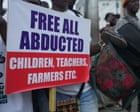
Abductions are resurging and may be spreading to new areas – with young children among the victims. A military response alone won’t work
E arly last month, Nigeria’s government announced the largest single-day hostage rescue in its history, with the freeing of ٣٠٠ people who had been taken in raids in two north central states. Celebrations were short-lived. Barely a fortnight later, gunmen abducted up to ٦٠٠ worshippers from a mosque in Niger state. Nigerians paid kidnappers nearly $٦m in ransoms in the year to June, according to a new report from the Lagos-based consultancy SBM Intelligence – more than triple the total in the previous ١٢-month period. More than ٧,٨٠٠ people were abducted, a two-thirds increase, and more than ١,١٠٠ killed, including almost ٩٠٠ civilians.
When Boko Haram abducted almost ٣٠٠ schoolgirls from their school in Chibok, Borno state in ٢٠١٤, it made headlines worldwide. Yet around ٤٥ children, mostly aged between two and five, remain missing after they were snatched from schools in Mussa , in north-eastern Borno state, in May. There is growing concern that kidnappings may be spreading to new areas. Forty-six students and staff were abducted from three schools in the south-western state of Oyo in the same month; they were rescued in July.
The kidnappings are just one facet of Nigeria’s multiple and overlapping security crises, which may be key to January’s presidential election. Boko Haram , its Islamic State West Africa Province offshoot and other jihadist groups are battling each other as well as terrorising civilians.
In the middle belt and parts of the south-west, violence pits predominantly Muslim Fulani herders against largely Christian farming communities. Climate stress and environmental despoliation are intensifying competition over land and resources. Because the two sides fall largely along religious lines, Donald Trump and American evangelicals have presented this conflict as if it were Nigeria’s entire security crisis, rather than one part of it.
The repercussions of abductions can be devastating even if hostages come home. Around ١٠٠ Chibok girls remain missing, while some returnees face rejection. Kidnapping also drives displacement, economic disruption and school closures, especially affecting girls in a country with a median age of just ١٨ and pervasive mass youth unemployment .
Many schools in Africa’s most populous country have simply closed . A safe schools protection initiative was laudable, but has limited effect without broader security improvements. Successive governments have failed to curb the violence. An overly centralised state and an overstretched security apparatus leave too many of Nigeria’s ٢٤٠ million people unprotected. State abandonment is forcing communities to seek their own accommodation with the perpetrators.
US strikes and a short-lived troop deployment were misconceived, with Mr Trump casting the complex violence, which has killed many Muslims too, as “Christian genocide”. Nigeria needs outside support rather than intervention. President Bola Tinubu announced a major military expansion and pay rise in July. But Christopher Musa, the country’s defence minister, has said that the military can only be ٣٠% of the solution; ٧٠% is socioeconomic. The army’s operational failures and grim human rights record, and the danger of other essentials being cut to pay for boosting defence, also counsel caution. Nigeria’s children and adults can’t be protected without better intelligence, improved collaboration among security institutions and with communities, and, above all, a fairer social and economic deal.
عندك رأي في القضايا اللي أثارها المقال دا؟ إذا حابب تبعث رد لحد ٣٠٠ كلمة عبر الإيميل عشان يتنظر للنشر في قسم الرسائل بتاعنا، من فضلك اضغط هنا.
تعليقات · ٠