A Guardian investigation has found that despite a recommendation to slow down, leading shipping companies continue to travel above advised speeds in a key habitat for cetaceans
M arine biologist Alice Barbarioli waits with her camera trained on the horizon. A few minutes earlier, the hydrophone beneath the Pelagos research vessel detected codas – the sequence of clicks sperm whales use to communicate.
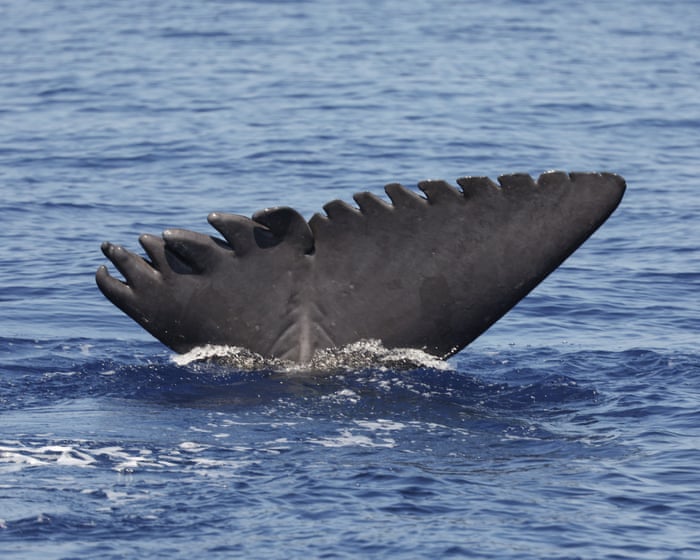
The sperm whale reveals its head and dorsal fin as those onboard the vessel in the Pelagos sanctuary, a conservation area established to protect marine mammals in the north-western Mediterranean, rush to take photos and note the rhythm of its breathing. After a few minutes, the animal arches its back, and begins to head back into the depths of the sea. They wait to catch a glimpse of its tail.
Barbarioli, the lead researcher of the citizen-science expedition, organised by the Tethys Research Institute, immediately notices an injury on its left fluke: “Given how precise the mark is, it’s probably the result of a [vessel] collision,” she says.
Collisions have long been recognised as a leading human-induced cause of death for the Mediterranean’s endangered sperm and fin whales. Now, a Guardian investigation using data from the maritime intelligence firm Veson Nautical, has found that large passenger and cargo vessels operated by four companies – the Grimaldi Group, Corsica Ferries, Baleària and Moby Lines – have frequently travelled through a protected habitat that includes the Pelagos sanctuary at ۱۵ knots (۱۷mph) or above – speeds that almost always kill cetaceans in cases of a collision. Strikes are unlikely to kill when a vessel is travelling below ۱۰ knots .
Slowing vessels is the most effective mitigation strategy when rerouteing isn’t possible, according to conservation NGO Oceancare.
The sea between Valencia and Genoa, which includes the Pelagos sanctuary, is a key cetacean habitat, home to about two-thirds of the Mediterranean’s fin whales and more than a fifth of its sperm whales. In July ۲۰۲۳, the International Maritime Organization (IMO) created the north-western Mediterranean Sea particularly sensitive sea area (PSSA). In a voluntary speed recommendation (VSR), it advised vessels weighing ۳۰۰ gross tonnes and above to sail at ۱۰ to ۱۳ knots in the area to reduce the risk of fatal collisions.
Despite the IMO’s recommendation, the Guardian, using additional data from Global Fishing Watch , found that ships with IMO identification numbers spent more than ۲۸۰,۰۰۰ hours travelling at ۱۵ knots and above through the PSSA in ۲۰۲۵. The data also showed that ships spent more than ۶,۰۰۰ hours travelling above ۲۵ knots. It builds on previous analysis that found the voluntary recommendations were largely ineffective.
In ۲۰۲۲ and ۲۰۲۵, ferries owned by the Grimaldi Group, including Cruise Roma – at more than ۲۵۰ metres, the world’s longest cruise ferry – dominated the top-۲۰ list of vessels spending the most time at ۱۵ knots or above in the habitat.
Speeding remained concentrated among a few operators in the PSSA in ۲۰۲۵, with just seven vessels – four Baleària fast ferries and three Grimaldi cruise ferries – responsible for ۷۰% of the hours spent above ۲۵ knot. Seven Grimaldi cruise ferries amounted to about ۸% of all hours recorded for all vessels at ۱۵ knots or above in ۲۰۲۵.
The Guardian spoke to six captains – five current and one former – who have sailed in the PSSA since its designation. The seafarers, still or previously at the helm of ships owned by Grimaldi Group and Moby Lines, say their companies have not introduced measures to encourage slow steaming after the IMO’s VSR.
“As long as it’s only a recommendation, nobody will reduce speed,” says one Grimaldi captain. “It would mean overhauling the whole commercial system. The ferries in the area travel at ۲۵ [knots], especially the ones carrying tourists. They have schedules to follow.”
Grimaldi and Moby Lines were contacted for comment but did not respond.
Thomas Folegot, the CEO of maritime tech company Quiet-Oceans, says that while slow-moving container vessels could stand to slightly cut speeds in the PSSA, it was far more challenging for ferries: “For their business, it’s a killer. [Passengers] will fly to Corsica.”
Quiet-Oceans and Oceancare’s analysis found that ۸۰% of the journeys by merchant ships in the PSSA in ۲۰۲۳ were at speeds above ۱۰ knots.
Simone Panigada, president of the Tethys Research Institute and chair of a scientific committee dedicated to the conservation of cetaceans, says it is time to “move, progressively, from voluntary to mandatory” rules on reducing collision risk.
“A binding framework would create more level conditions for all operators, encouraging compliance among shipping companies and ensuring the adoption of these measures doesn’t rest solely on individual corporate decisions,” he says.
The International Whaling Commission (IWC) told the Guardian it has recorded six incidents since July ۲۰۲۳ in the PSSA: five near-miss events and one collision. It believes most strikes go unrecorded .
While the annual time spent travelling through the PSSA above the key threshold of ۱۵ knots remained high in ۲۰۲۵, it represented an ۱۱% reduction compared with ۲۰۲۲. The time above ۲۵ knots also fell by about a third between ۲۰۲۲ and ۲۰۲۵.
These overall declines are probably caused by factors including altered shipping routes, says Olivia Watkins, associate director at Veson Nautical, who adds: “The PSSA recommendation is unlikely to be a significant cause of the year-on-year decline in the data results.”
Wei-Jun Mun, director of public policy at the World Shipping Council, says the industry is committed to PSSA’s protective measures, while noting slower navigation involved “commercial trade-offs and operational concerns”, including having to add ships to a service for schedule reliability.
A spokesperson for Corsica Ferries says the company supports Mediterranean marine megafauna research and ship-strike mitigation through measures including continuous monitoring, crew training and the development of whale alert tools. Researchers from programmes including conservation project Life Conceptu Maris monitor wildlife using its ships, it says.
The company says it instructs captains to navigate with particular caution through the PSSA, and to lower speeds to ۱۰ to ۱۳ knots, “while seeking to avoid possible negative impacts of reduced speeds”, including on manoeuvrability. It says its captains have reported a reduced capacity to avoid cetaceans that appear suddenly when navigating at reduced speeds.
A spokesperson for Baleària says it is “committed to the conservation of marine biodiversity” and actively working to mitigate the risk of collisions, including through crew training and the use of real-time monitoring systems to allow captains to adjust speed and course where necessary. Baleària says none of its fast ferries had recorded a collision with cetaceans.
Baleària adds that it participates in marine conservation programmes, including the Life Conceptu Maris and Life Intemares initiatives.
This article was developed with the support of Journalismfund Europe and in collaboration with Magma magazine
Comments · ۰